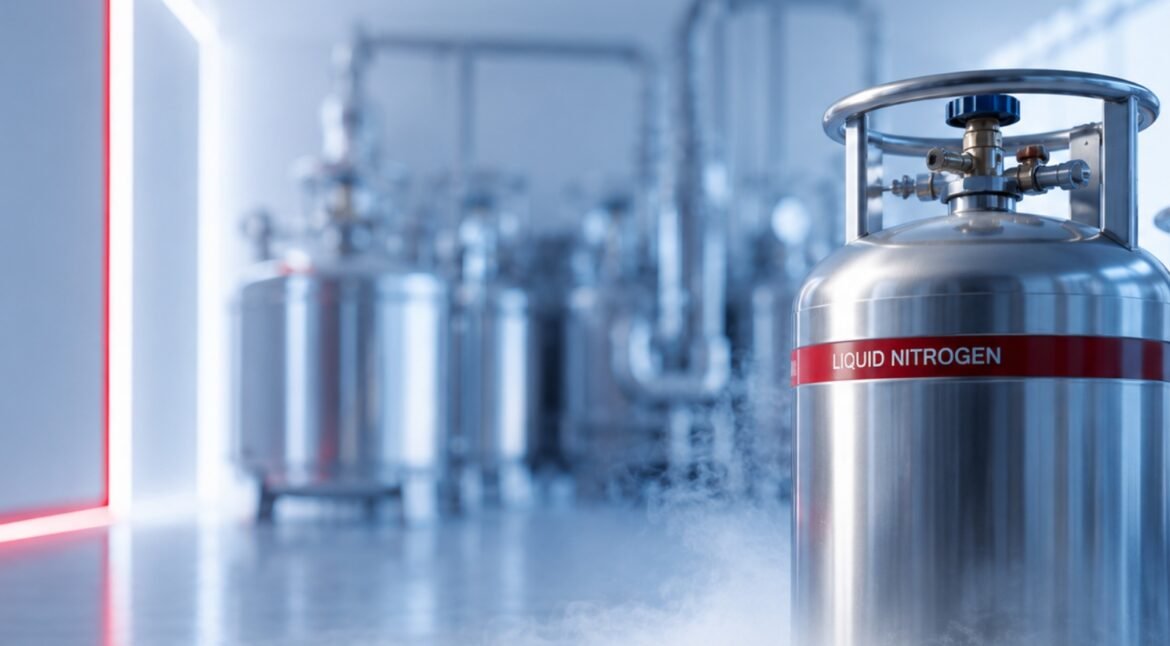
Liquid nitrogen is a routine part of laboratory and research work. It preserves samples, cools instruments and materials, and supports experiments that need stable low temperatures. For a lab, the challenge is less about using liquid nitrogen and more about getting it reliably, storing it properly and handling it safely. This guide covers liquid nitrogen for laboratories and research facilities: common uses, supply options, storage and safety, and how to choose the right format for your lab.
How Laboratories Use Liquid Nitrogen
Liquid nitrogen boils at about −196 °C and is largely inert, which makes it useful for many laboratory tasks. Common uses include:
- Sample preservation: storing biological samples, cells and other specimens at cryogenic temperatures for long periods.
- Cooling instruments: some analytical and scientific instruments use liquid nitrogen for cooling.
- Freezing and grinding samples: chilling samples so they can be broken down or processed while cold.
- Low-temperature experiments: providing a stable, very cold environment for testing and research.
- Teaching and demonstration: under controlled conditions, in teaching laboratories.
Who Needs a Reliable Liquid Nitrogen Supply?
- Research laboratories in universities and institutes;
- testing and analytical laboratories;
- biological and biotechnology laboratories;
- pharmaceutical and quality-control laboratories;
- laboratories in healthcare settings.
For all of them, running out of liquid nitrogen can put stored samples and planned work at risk, so supply planning matters.
Liquid Nitrogen Supply for Labs
Spectra Cryogenic Systems supplies liquid nitrogen from Kota, Rajasthan, for industrial, medical, research and food processing use. Bulk tanker supply is available across India in quantities of 6,000 L and 13,000 L, with a minimum order of 2,000 L.
How a lab receives and stores liquid nitrogen depends mainly on how much it uses and how it uses it.
Storage Options for Laboratories
Liquid Nitrogen Containers
Open-neck, non-pressurised liquid nitrogen containers are the most common choice for sample storage and small quantities. Spectra’s containers range from 1 L to 51 L, with holding times typically between 15 and 60 days, depending on the model.
Liquid Cylinders
Closed, pressurised liquid cylinders can act as an on-site reservoir for refilling containers or supplying liquid to equipment. Spectra supplies liquid cylinders from 180 L to 240 L as a distributor.
Bulk Storage
Laboratories or facilities with steady, higher consumption may use a storage tank filled by tanker.
For a full comparison, read LN2 Supply Options: Containers, Liquid Cylinders or Bulk Tanker?
Choosing the Right Format for Your Lab
| Lab situation | Format usually considered |
|---|---|
| Sample storage with small, occasional top-ups | Liquid nitrogen containers |
| Several containers refilled regularly, or equipment needing a regular supply | Liquid cylinder as an on-site reservoir, plus containers |
| Steady, higher consumption across a facility | Bulk storage tank filled by tanker |
Many labs combine formats: containers for samples, and a liquid cylinder or bulk tank as the main supply.
Storage Considerations
- Location: store vessels in a well-ventilated area, never in small enclosed rooms or cupboards.
- Space: plan floor space and access for vessels and for refilling.
- Levels: record liquid nitrogen levels and refill well before they become low.
- Inventory: keep a record of samples so containers are not opened unnecessarily.
- Condition: check vessels for damage, frost or unusually fast liquid loss, and have them inspected if needed.
Planning for Continuity
Laboratory work rarely stops neatly, and samples need liquid nitrogen every day of the year. When planning supply, consider:
- Holidays and shutdowns: make sure containers are topped up and supply is arranged before periods when the lab is closed or lightly staffed.
- Responsibility: name who checks levels and who orders supply, with a back-up person.
- Margins: refill well before levels become low, rather than waiting for the last moment.
- Critical samples: identify which containers hold irreplaceable material and check them more often.
Safety in the Laboratory
- Oxygen depletion: evaporating nitrogen can reduce oxygen levels in enclosed or poorly ventilated rooms. Assess ventilation and, where appropriate, oxygen monitoring.
- Cold burns: use cryogenic gloves, a face shield over safety goggles, and an apron for filling and transfer.
- Pressure: never seal liquid nitrogen in a container not designed for it.
- Training: make sure everyone who handles liquid nitrogen, including occasional users and students, is trained.
For filling and decanting, see Safe Filling and Transfer of Liquid Nitrogen.
Questions to Ask Your Liquid Nitrogen Supplier
- Which supply format suits our usage and our building?
- What quantities and minimum order apply to bulk supply?
- Which container capacities and holding times suit our samples?
- Can you supply storage vessels and cryogenic safety equipment as well?
- Who do we contact if a container is damaged or losing liquid too quickly?
Frequently Asked Questions
Does Spectra supply liquid nitrogen for research laboratories?
Yes. Spectra Cryogenic Systems supplies liquid nitrogen for industrial, medical, research and food processing use.
Can liquid nitrogen be delivered to labs outside Rajasthan?
Spectra supplies bulk liquid nitrogen by tanker across India, in quantities of 6,000 L and 13,000 L, with a minimum order of 2,000 L.
What containers suit laboratory sample storage?
Liquid nitrogen containers are commonly used. Spectra offers them from 1 L to 51 L, with holding times typically between 15 and 60 days depending on the model.
What is the main safety risk of liquid nitrogen in a lab?
Besides cold burns, the main risk is oxygen depletion in poorly ventilated spaces, which is why ventilation and storage location are so important.
Plan Your Lab’s Liquid Nitrogen Supply
To discuss liquid nitrogen supply, storage containers or safety equipment for your laboratory, contact Spectra Cryogenic Systems Pvt. Ltd. on +91 98290 89936 or at spectracryo@yahoo.com.