When samples are stored in liquid nitrogen, there is more than one way to do it. Samples can sit in the liquid itself, or above it in the cold nitrogen vapour. The choice between vapour phase and liquid phase liquid nitrogen storage affects how stable the storage temperature is, how samples are handled and how the storage vessel is managed. This guide explains the two approaches, the trade-offs between them and what to consider when deciding which suits your samples.
A Quick Background: Cryogenic Storage
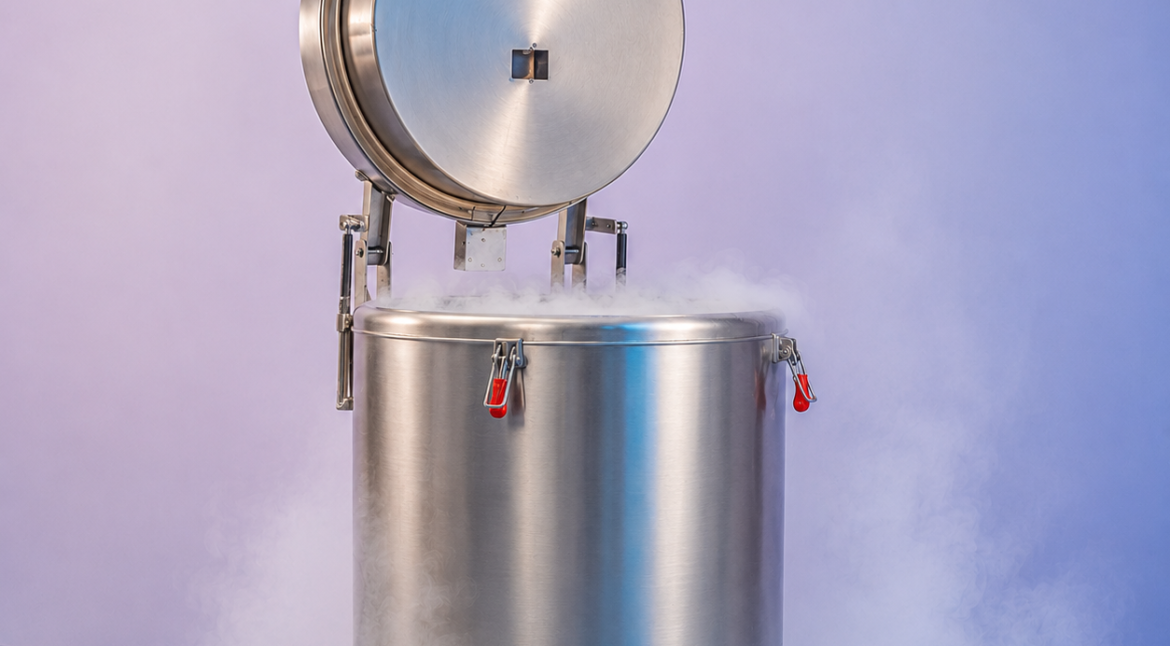
Liquid nitrogen boils at about −196 °C at atmospheric pressure. Storing material in or near it keeps the material at very low temperatures, which is why liquid nitrogen is used for long-term preservation of biological samples, cells, frozen semen and other sensitive materials. The storage vessel, whether a container, dewar or storage chamber, is vacuum-insulated to slow the evaporation of the liquid nitrogen.
Within that vessel, samples can be positioned in two different places, and that is what “liquid phase” and “vapour phase” refer to.
What Is Liquid-Phase Storage?
In liquid-phase storage, samples are held below the surface of the liquid nitrogen, fully immersed in it.
Characteristics commonly associated with liquid-phase storage:
- Very stable temperature: immersed samples stay at the temperature of the liquid nitrogen itself.
- A thermal buffer: the surrounding liquid helps protect samples from temperature changes when the vessel is opened briefly.
- Simple concept: as long as samples stay below the liquid level, they stay cold.
Points to consider:
- If sample containers are not designed and sealed for immersion, liquid nitrogen can get inside them. When such a container warms up, the trapped liquid expands rapidly as it turns to gas, which can cause the container to rupture.
- Because samples share the same liquid, the possibility of cross-contamination between samples through the liquid is often discussed as a consideration.
- Retrieving samples means working directly with liquid nitrogen, with the associated splash and cold-burn hazards.
What Is Vapour-Phase Storage?
In vapour-phase storage, samples are held above the liquid, in the cold nitrogen vapour that forms as the liquid evaporates. The liquid nitrogen stays in the lower part of the vessel, and the samples do not sit in it.
Characteristics commonly associated with vapour-phase storage:
- No immersion: samples are not in direct contact with the liquid, which reduces the risk of liquid entering sample containers.
- Separation from the liquid: this is often considered where sharing liquid between samples is a concern.
- Different handling: retrieving samples may involve less direct contact with the liquid itself.
Points to consider:
- Temperature varies with position: the vapour is coldest close to the liquid and warmer further away from it, so a sample’s temperature depends on where it sits in the vessel.
- Liquid level matters: as the liquid level falls, the vapour above it can become warmer, so levels need closer management.
- Less thermal buffer: opening the vessel can affect vapour-phase samples more quickly than immersed samples.
Conceptual Comparison
| Liquid phase | Vapour phase | |
|---|---|---|
| Where samples sit | Immersed in liquid nitrogen | Above the liquid, in cold nitrogen vapour |
| Temperature stability | Very stable while immersed | Varies with position and liquid level |
| Contact with liquid | Direct | None during storage |
| Sample container requirements | Must be suitable for immersion | Must be suitable for cryogenic vapour storage |
| Level management | Keep samples below the liquid surface | Keep the liquid level within the range the vessel is designed for |
Neither method is universally better. The right choice depends on the samples, the sample containers, the vessel design and the procedures of the organisation storing them.
Why the Storage Method Matters
- Sample integrity: the method affects the temperature conditions samples experience over time.
- Safety: immersion carries the risk of liquid entering and rupturing unsuitable containers; vapour storage requires careful level management.
- Handling: the method affects how samples are retrieved and what PPE is needed.
- Procedures: many organisations have their own requirements for how particular samples must be stored.
Sample and Application Considerations
- What type of samples are being stored, and are there established procedures for them in your field?
- Are the sample containers designed for immersion, for vapour storage, or both?
- How often will samples be accessed?
- How important is separation between samples from different sources?
Container and Vessel Configuration
The vessel needs to suit the chosen method. Points to discuss with your supplier include capacity, neck or opening size, how samples are organised inside, and how the liquid level is checked. Spectra Cryogenic Systems offers liquid nitrogen containers from 1 L to 51 L and a biological sample storage chamber in open-mouth and rotating configurations. Ask which storage method a particular vessel is suited to before you buy. For terminology, see Cryocan vs Dewar vs LN2 Container.
Monitoring and Handling
- Check liquid levels regularly and record them, especially for vapour-phase storage.
- Consider temperature monitoring where sample value or procedures require it.
- Keep openings short to limit warming.
- Keep an inventory so samples can be found quickly without searching.
- Use suitable PPE, such as cryogenic gloves and face protection, when accessing samples.
- Store vessels in well-ventilated areas, as evaporating nitrogen can reduce oxygen levels in enclosed spaces.
Frequently Asked Questions
What is the difference between vapour-phase and liquid-phase storage?
In liquid-phase storage, samples are immersed in liquid nitrogen. In vapour-phase storage, samples are held above the liquid in cold nitrogen vapour.
Is vapour-phase storage better than liquid-phase storage?
Neither is universally better. Liquid phase offers very stable temperatures; vapour phase avoids immersion. The right choice depends on the samples, containers and procedures.
Why does the liquid level matter in vapour-phase storage?
The vapour is coldest near the liquid. As the level falls, the vapour around the samples can become warmer, so levels need careful management.
Can liquid nitrogen get into sample containers?
If containers are not designed and sealed for immersion, liquid can enter them in liquid-phase storage and expand rapidly when they warm, which can cause rupture.
Talk to Spectra About Cryogenic Storage
To discuss liquid nitrogen containers or biological sample storage for your application, contact Spectra Cryogenic Systems Pvt. Ltd. on +91 98290 89936 or at spectracryo@yahoo.com.