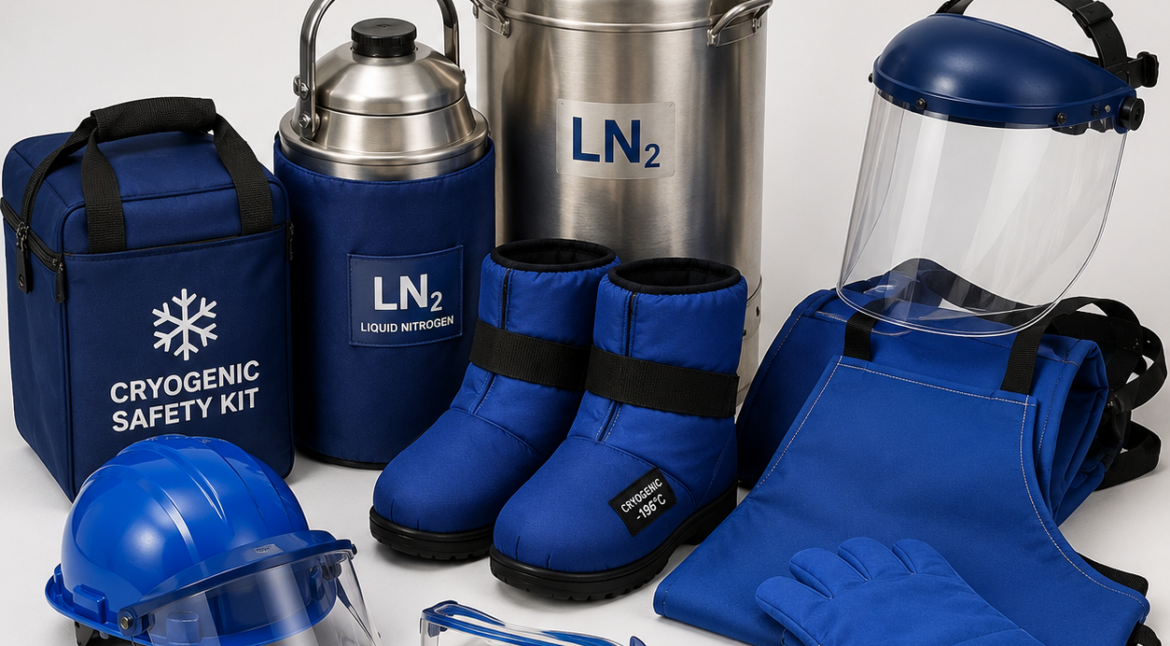
Laboratories that use liquid nitrogen need cryogenic safety equipment that matches the work they actually do. Buying the wrong items, the wrong sizes or too few sets leaves gaps that people fill by improvising. This guide is for lab managers, safety officers and purchasing teams looking for a cryogenic safety equipment supplier. It explains how to evaluate cryogenic PPE for laboratory work, how to match equipment to tasks, and what to ask a supplier before you buy.
For a task-by-task guide to wearing PPE, see What PPE Is Needed When Handling Liquid Nitrogen? This article focuses on choosing and buying it.
Why PPE Selection Matters in the Lab
Liquid nitrogen boils at about −196 °C. In a laboratory, people come into contact with it when filling containers, retrieving samples, decanting small quantities and cooling equipment. The main cold hazards are splashes, contact with super-cooled surfaces and cold vapour. Suitable PPE reduces the risk of cold burns from these hazards, but only if:
- it is designed for cryogenic work, not general lab use;
- it fits the people who wear it;
- there is enough of it, in the right places, for everyone who needs it;
- it is replaced when worn or damaged.
Good selection makes the safe way of working the easy way.
The Main Categories of Cryogenic PPE
Hand Protection: Cryogenic Gloves
Cryogenic gloves are insulated gloves designed for handling cold items and for protection against brief contact with cold liquid and vapour. When evaluating gloves for a lab, consider:
- Length: whether wrist or longer forearm coverage suits the task, for example reaching into a container.
- Fit and dexterity: lab work often involves handling small canisters, racks or sample boxes, so gloves need to allow enough grip and movement.
- Removal: gloves should be loose enough to be pulled off quickly if liquid gets inside.
- Sizes: stock a range of sizes so every user has a glove that fits.
Face and Eye Protection: Face Shields and Safety Goggles
Splashes can happen without warning, particularly during filling and when items are lowered into liquid nitrogen. Labs usually need both:
- Safety goggles to protect the eyes;
- Face shields worn over goggles for filling, pouring and transfer work, to protect the whole face.
Check that face shields are compatible with the goggles staff will wear underneath, and with any prescription spectacles.
Body Protection: Aprons and Protective Clothing
Cryogenic aprons protect the front of the body and legs during pouring and filling. Protective clothing should cover the arms and legs fully. Consider the sizes needed, how aprons will be stored, and whether they suit the space people work in.
Other Cryogenic PPE and Accessories
Depending on your work, other cryogenic PPE and safety accessories may be useful. Discuss your tasks with your supplier rather than buying items you will not use.
Matching Equipment to the Task
The best way to decide what to buy is to list the liquid nitrogen tasks carried out in your lab and who does them.
| Typical lab task | Main hazards | PPE to plan for |
|---|---|---|
| Retrieving samples from a container | Cold surfaces, cold vapour, drips | Cryogenic gloves, safety goggles; face shield if splashing is possible |
| Topping up or filling containers | Splashes, cold vapour | Face shield over goggles, cryogenic gloves, cryogenic apron |
| Decanting small quantities | Splashes | Face shield over goggles, cryogenic gloves, apron |
| Cooling equipment or materials | Splashes, violent boiling when warm items are added | Face shield over goggles, cryogenic gloves, apron |
Use this as a starting point. Your own risk assessment should decide the final requirement.
How Many Sets Do You Need?
- Points of use: keep PPE where liquid nitrogen is handled, not in a central store far away.
- Number of users: account for everyone who handles liquid nitrogen, including occasional users and night or weekend staff.
- Sizes: gloves and aprons need to fit different users.
- Spares: keep replacements so damaged items can be withdrawn straight away.
Appropriate Use Considerations
- Cryogenic gloves are for cold handling and brief contact, not for putting hands into liquid nitrogen. Use tongs or suitable tools.
- Wet or damaged gloves lose their protection and should be replaced.
- PPE does not protect against oxygen depletion. Ventilation and safe storage locations remain essential; see our Cryogenic Storage Area Safety Checklist.
- Staff should be trained in how to wear, remove, inspect and store their PPE.
Questions to Ask a Cryogenic Safety Equipment Supplier
- Which items do you supply for the tasks we carry out?
- What sizes are available for gloves, aprons and clothing?
- What information is provided with each product about its intended use and limitations?
- Which items are suitable for filling and transfer work, and which for sample handling?
- How should the equipment be stored, inspected and cared for?
- Can you supply the liquid nitrogen and storage equipment we use as well?
Ask the supplier for the product information for each item and keep it with your lab safety records.
Frequently Asked Questions
What cryogenic safety equipment does Spectra supply?
Spectra Cryogenic Systems supplies cryogenic gloves, face shields, safety goggles, aprons, protective clothing, other cryogenic PPE and safety accessories.
Are ordinary lab gloves suitable for liquid nitrogen work?
No. Thin laboratory gloves do not insulate against cryogenic temperatures. Use insulated cryogenic gloves designed for cold handling.
Does a lab need both goggles and face shields?
For filling, pouring and transfer work, a face shield worn over safety goggles is recommended, because splashes can reach the whole face.
Does PPE protect against oxygen depletion?
No. Oxygen depletion is managed through ventilation, safe storage locations and, where appropriate, oxygen monitoring.
Spectra also supplies cryogenic accessories such as dewar flasks, valves and regulators for laboratory cryogenic work.
Equip Your Lab with Cryogenic Safety Equipment
Spectra Cryogenic Systems Pvt. Ltd. supplies cryogenic safety equipment for laboratories and other liquid nitrogen users. To discuss the PPE your team needs, call +91 98290 89936 or email spectracryo@yahoo.com. Tell us which tasks you carry out and how many people handle liquid nitrogen.