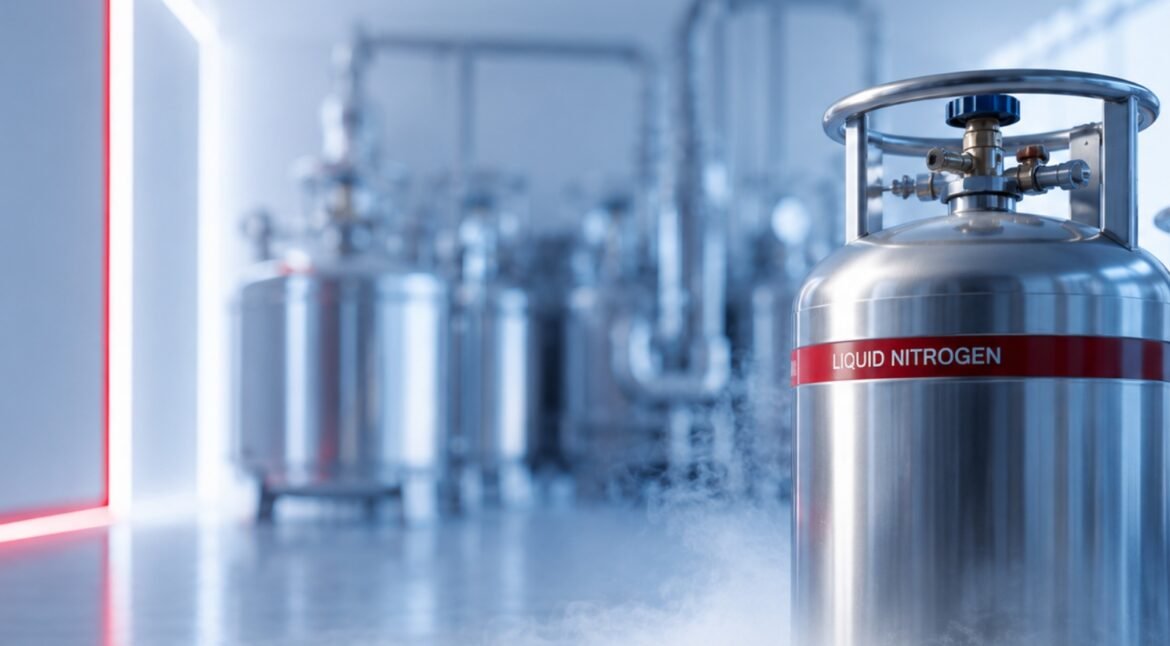
Cryogenic grinding depends on one input above all others: liquid nitrogen. It is what turns an ordinary mill into a cryogenic process, and it shapes how the line is designed, operated, supplied and kept safe. This article focuses specifically on liquid nitrogen for cryogenic grinding: why it is used, how its cooling supports the grinding process, what that means for heat-sensitive and oily materials, and what a processor needs to plan for in supply and safety.
If you are new to the process itself, start with What Is Cryogenic Grinding? This article picks up from there and looks at the liquid nitrogen side in more detail.
Why Liquid Nitrogen Is the Usual Choice
Several properties make liquid nitrogen well suited to cooling materials for grinding:
- Very low temperature: it boils at about −196 °C at atmospheric pressure, so it can chill material rapidly.
- High cooling capacity as it evaporates: as liquid nitrogen turns into gas, it absorbs heat from whatever it touches.
- No residue: it evaporates completely, so nothing is left in the product.
- Largely inert: nitrogen reacts with very few substances, and the gas it produces displaces air in the grinding zone.
- Widely available: it can be delivered and stored in insulated vessels designed for cryogenic liquids.
How Liquid Nitrogen Cooling Supports Grinding
1. Pre-Cooling the Material
In a typical cryogenic grinding line, the material is chilled before it reaches the mill. This often happens in a cooling stage such as a screw-type cooler, where the material is conveyed while liquid nitrogen is introduced. By the time the material enters the mill, it is cold, firm and more brittle.
2. Absorbing Grinding Heat
Grinding generates heat through friction and impact. In a cryogenic process, that heat is absorbed by the cold material and by the evaporating nitrogen, which helps keep temperatures in the grinding zone low.
3. Creating a Nitrogen-Rich Atmosphere
Evaporating liquid nitrogen fills the cooling and grinding stages with nitrogen gas, displacing much of the air. Because nitrogen is largely inert, this can help limit oxidation of sensitive components during grinding.
4. Controlled Dosing
Liquid nitrogen is fed through a control system so the material is cooled enough for the process, without unnecessary use. How much liquid nitrogen a line uses depends on the material, its starting temperature, the output required and the system design. Ask your supplier how consumption is estimated for your material.
Heat-Sensitive and Oily Materials
The benefits of liquid nitrogen cooling are most visible with two types of material:
- Heat-sensitive and aromatic materials, such as spices and herbs, where keeping the material cold helps reduce the loss of volatile oils and aroma during grinding.
- Oily and greasy materials, which soften and smear when warm. Chilling them with liquid nitrogen makes them firmer, so they are more likely to fracture into particles than to clog the mill.
The right level of cooling differs from one material to another, which is why process settings are normally established for each application.
Planning Your Liquid Nitrogen Supply
A cryogenic grinding line cannot run without liquid nitrogen, so supply planning is as important as the grinding equipment itself.
- Estimate usage: work with your supplier to understand what drives consumption for your material and planned output.
- Choose on-site storage: the line draws liquid nitrogen from on-site storage, sized to your usage and delivery pattern.
- Plan deliveries: sites with steady, higher consumption often use bulk tanker supply into a storage tank. Spectra Cryogenic Systems supplies liquid nitrogen, including bulk tanker supply across India in quantities of 6,000 L and 13,000 L, with a minimum order of 2,000 L.
- Allow access: plan a safe route and space for tanker access and for the storage vessel.
- Keep a margin: make sure production is not interrupted because the storage vessel runs low.
Safety Considerations
Introducing liquid nitrogen into a production area brings specific hazards that must be managed:
- Oxygen depletion: evaporating nitrogen can reduce the oxygen level in poorly ventilated spaces. Nitrogen has no colour or smell, so it cannot be detected by people. Good ventilation, and where appropriate oxygen monitoring, are important.
- Cold burns: liquid nitrogen, cold gas and chilled surfaces such as pipework and cooling equipment can cause cold burns. Operators need suitable PPE; see What PPE Is Needed When Handling Liquid Nitrogen?
- Trapped liquid: liquid nitrogen trapped in a closed section of pipe or vessel can build pressure as it warms. Systems must be designed and operated so liquid cannot be trapped.
- Training: operators and maintenance staff should understand the hazards and the correct procedures for the line.
What to Discuss with Your Supplier
- How is liquid nitrogen introduced to the material, and how is it controlled?
- What affects liquid nitrogen consumption for my material and output?
- What on-site storage do I need, and how will it be refilled?
- How is evaporated nitrogen gas handled and vented from the line?
- What ventilation and oxygen monitoring should the grinding area have?
- What PPE and training will operators need?
- Can the system be customised for my material?
Frequently Asked Questions
Why is liquid nitrogen used in cryogenic grinding?
It chills material quickly, absorbs heat generated during grinding, evaporates without leaving residue and creates a nitrogen-rich atmosphere in the grinding zone.
How much liquid nitrogen does cryogenic grinding use?
It depends on the material, its starting temperature, the required output and the system design. Your supplier should help estimate consumption for your application.
Can Spectra supply the liquid nitrogen as well as the grinding system?
Yes. Spectra Cryogenic Systems offers cryogenic grinding systems and also supplies liquid nitrogen, including bulk tanker supply across India.
Is liquid nitrogen dangerous in a grinding plant?
It can be if not managed properly. The main hazards are oxygen depletion, cold burns and pressure from trapped liquid, all of which are controlled through design, ventilation, training and PPE.
Plan Your Cryogenic Grinding and LN2 Supply Together
Spectra Cryogenic Systems Pvt. Ltd. offers cryogenic grinding systems and liquid nitrogen supply. To discuss your material, the grinding system and your liquid nitrogen requirement, call +91 98290 89936 or email spectracryo@yahoo.com.