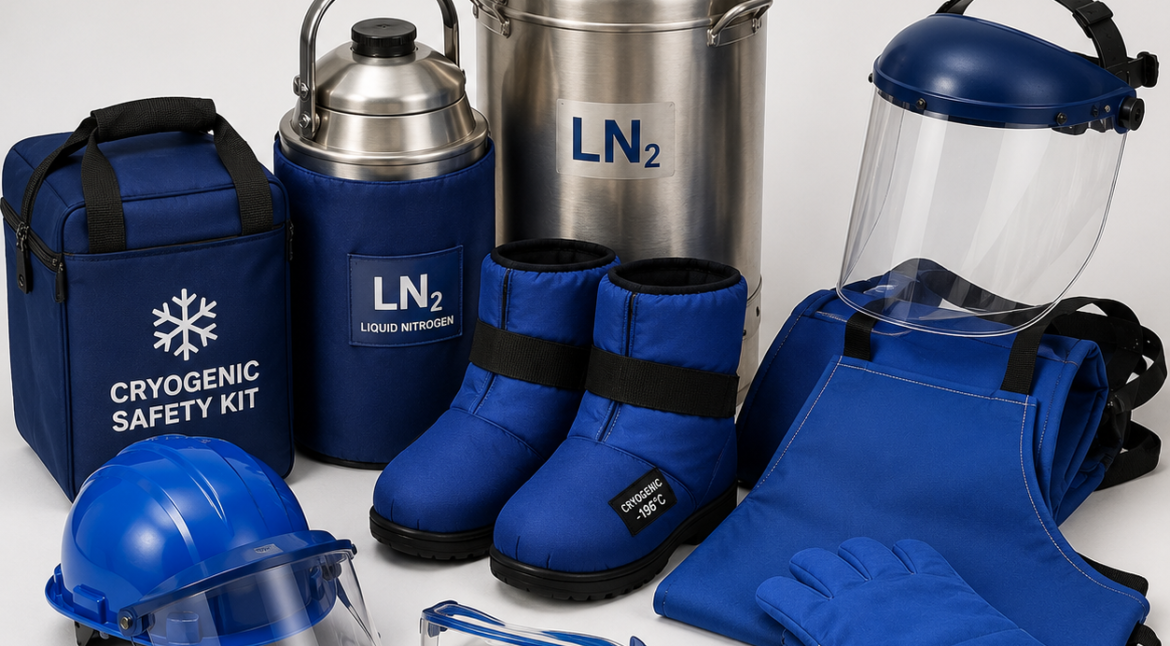
Liquid nitrogen is used every day in laboratories, hospitals, veterinary centres, food plants and workshops. Handled correctly, it is a safe and practical material. Handled without protection, it can cause serious cold burns in seconds. This guide explains what PPE is needed when handling liquid nitrogen, why each item matters, and which tasks call for which level of protection.
Why Liquid Nitrogen Needs Specific PPE
Liquid nitrogen boils at about −196 °C. At that temperature, three things can injure the people handling it:
- Splashes of liquid during filling, pouring or transferring.
- Contact with super-cooled surfaces such as transfer hoses, metal fittings, canisters and the items lifted out of a container.
- Cold vapour escaping from the neck of a container or from a transfer line.
Ordinary work gloves, safety spectacles and lab coats are not designed for these hazards. Cryogenic PPE is.
The Essential Liquid Nitrogen PPE
1. Eye and Face Protection: Safety Goggles and a Face Shield
The eyes are the most vulnerable part of the body around liquid nitrogen. A splash can occur without warning, for example when warm items are lowered into the liquid and it boils violently. Wear safety goggles and, for filling, pouring and transfer work, a full face shield over them. The face shield protects the whole face; the goggles protect the eyes if liquid reaches behind the shield.
2. Hand Protection: Cryogenic Gloves
Cryogenic gloves are insulated gloves designed for handling very cold items and for protection against brief contact with cold liquid and vapour. Choose gloves that:
- are loose enough to be pulled off quickly if liquid gets inside;
- cover the wrist and lower forearm, so splashes cannot run into the cuff;
- still allow enough dexterity for the task, such as handling canisters or sample boxes.
Cryogenic gloves are not designed for putting your hands into liquid nitrogen. Use tongs or other tools to lift items from the liquid.
3. Body Protection: Cryogenic Apron and Protective Clothing
A cryogenic apron protects the front of the body and legs, where splashes are most likely during pouring and filling. Underneath, wear long sleeves and full-length trousers made of a material that does not absorb liquid quickly. Clothing should cover the skin fully.
4. Leg and Foot Protection
Wear closed shoes or safety boots that cover the whole foot. Trousers should be worn outside the shoes or boots and should not have turn-ups (cuffs), so that a splash runs off rather than collecting next to the skin or inside the footwear.
5. Remove Jewellery and Watches
Rings, bracelets and metal watch straps cool quickly and can trap liquid against the skin. Remove them before handling liquid nitrogen.
What PPE Cannot Protect Against
Personal protective equipment protects against cold contact. It does not protect against the other main hazard of liquid nitrogen: oxygen depletion. As liquid nitrogen evaporates, nitrogen gas can displace the oxygen in a room. Nitrogen has no colour or smell, so people cannot detect it.
Protection against oxygen depletion comes from the workplace, not from PPE:
- Use and store liquid nitrogen in well-ventilated areas.
- Avoid small, enclosed rooms, cupboards and basements for storage or filling.
- Where liquid nitrogen is used indoors in larger quantities, consider an oxygen monitor with an alarm.
- Never travel in a closed vehicle cabin with a liquid nitrogen container.
Our guide to liquid nitrogen explains these properties in more detail.
PPE by Task: A Practical Guide
| Task | Typical hazards | Recommended PPE |
|---|---|---|
| Lifting canisters or sample boxes from a liquid nitrogen container | Cold surfaces, cold vapour, drips | Cryogenic gloves, safety goggles, long sleeves; face shield if splashing is possible |
| Pouring or decanting liquid nitrogen into a smaller vessel | Splashes, cold vapour | Face shield over goggles, cryogenic gloves, cryogenic apron, closed shoes |
| Filling a container from a liquid cylinder or supply line | Splashes, cold hoses and fittings, vapour release | Face shield over goggles, cryogenic gloves, cryogenic apron, full-length clothing, closed shoes |
| Placing warm items into liquid nitrogen | Violent boiling and splashing | Face shield over goggles, cryogenic gloves, apron; use tongs and lower items slowly |
| Moving or transporting a filled container | Spills if the container tips | Cryogenic gloves, closed shoes; keep the container upright and secured |
This table is general guidance. Your own risk assessment, your site procedures and the instructions for your equipment should always take priority.
Common Liquid Nitrogen PPE Mistakes
- Wearing goggles but no face shield while pouring. Splashes during pouring and filling can reach the cheeks, neck and forehead.
- Tight gloves tucked under sleeves. Liquid that runs down the arm can collect inside the glove. Gloves should be loose enough to remove quickly, with cuffs that keep splashes out.
- Trousers tucked into boots. A splash can run straight into the footwear and stay in contact with the skin.
- Using wet gloves. Moisture reduces insulation and can freeze, holding the cold against the hand.
- Skipping PPE for “quick” jobs. Many injuries happen during short, routine tasks such as topping up a container or lifting out a single canister.
- Relying on PPE alone. PPE does not address oxygen depletion. Ventilation and safe storage locations are still essential.
Looking After Cryogenic PPE
- Inspect before use: check gloves for tears, worn areas or damaged seams, and face shields for cracks.
- Keep gloves dry: wet or damp gloves lose their insulating ability and can freeze to the skin.
- Replace damaged items rather than repairing them.
- Store PPE near the point of use, so that nobody is tempted to “just do it quickly” without protection.
- Train everyone who handles liquid nitrogen, including occasional users, on how to wear and remove PPE.
Frequently Asked Questions
Are ordinary lab gloves enough for liquid nitrogen?
No. Thin laboratory gloves offer no insulation against cryogenic temperatures. Use insulated cryogenic gloves designed for cold handling.
Is a face shield necessary, or are goggles enough?
For pouring, filling and transfer work, a full face shield worn over safety goggles is recommended, because splashes can reach the whole face.
Can I put my gloved hand into liquid nitrogen?
No. Cryogenic gloves protect against brief contact and cold items, not immersion. Use tongs or suitable tools.
Does PPE protect against oxygen depletion?
No. Ventilation, safe storage locations and, where appropriate, oxygen monitoring are needed to manage that hazard.
Cryogenic Safety Equipment from Spectra
Spectra Cryogenic Systems Pvt. Ltd. supplies cryogenic safety equipment, including cryogenic gloves, face shields, safety goggles, aprons, protective clothing, other cryogenic PPE and safety accessories. We also supply liquid nitrogen and storage equipment. To discuss the PPE your team needs, call +91 98290 89936 or email spectracryo@yahoo.com.