Liquid nitrogen is one of the most widely used cryogenic liquids in industry, healthcare and research. It freezes food in seconds, preserves biological samples for years, cools materials for grinding and helps fit metal parts together without force. This guide explains what liquid nitrogen is, how it is made, its key properties, where it is used and what it takes to handle it safely.
What Is Liquid Nitrogen?
Liquid nitrogen (often written LN2 or LN₂) is nitrogen gas that has been cooled until it becomes a liquid. Nitrogen makes up roughly 78% of the air we breathe, so it is not an exotic substance. What makes liquid nitrogen special is its temperature: at normal atmospheric pressure it boils at about −196 °C.
Because it is so cold, liquid nitrogen is described as a cryogenic liquid. Anything it touches is cooled rapidly, which is exactly why it is so useful, and why it must be handled with care.
How Is Liquid Nitrogen Produced?
Liquid nitrogen is produced from ordinary air in an air separation plant. In simple terms, the process works like this:
- Air is filtered and compressed to remove dust and prepare it for cooling.
- Moisture and carbon dioxide are removed, because they would freeze and block the equipment.
- The air is cooled until it liquefies.
- The liquid air is separated by fractional distillation. Nitrogen, oxygen and argon boil at different temperatures, so they can be drawn off separately.
The liquid nitrogen is then stored in insulated tanks and delivered to users by road tanker, or filled into smaller vessels such as liquid cylinders and liquid nitrogen containers.
Key Properties of Liquid Nitrogen
- Extremely cold: about −196 °C at atmospheric pressure.
- Colourless and odourless: neither the liquid nor the gas it produces can be seen or smelt. The white “fog” around liquid nitrogen is moisture in the air condensing, not the nitrogen itself.
- Non-flammable: nitrogen does not burn and does not support combustion.
- Largely inert: nitrogen reacts with very few substances under normal conditions, which is why nitrogen gas is used to protect products and processes from oxygen.
- Large expansion: when liquid nitrogen warms and turns back into gas, it expands to roughly 700 times its liquid volume. This is important for both storage and safety.
- Continuous evaporation: liquid nitrogen is always slowly boiling at room temperature. Storage vessels are designed to slow this down, not stop it.
Where Is Liquid Nitrogen Used?
Its combination of very low temperature and inertness makes liquid nitrogen useful in many sectors.
Biological Storage and Healthcare
Liquid nitrogen keeps biological material such as cells, tissues, frozen semen and embryos at very low temperatures for long-term preservation. It is also used in medical and healthcare settings, for example in laboratory work and in some clinical treatments that use extreme cold.
Animal Breeding and Veterinary Work
Frozen semen straws used in artificial insemination programmes are stored and transported in liquid nitrogen containers, so that the genetic material remains viable until it is used.
Food Processing and Freezing
Liquid nitrogen freezes food very quickly. Rapid freezing helps limit the size of ice crystals that form inside food, which helps protect texture. Nitrogen gas is also used to displace oxygen in food packaging.
Research Laboratories
Laboratories use liquid nitrogen to cool instruments and samples, to preserve specimens and for experiments that need stable low temperatures.
Manufacturing and Engineering
- Cryogenic grinding: materials are chilled so they become brittle and easier to grind, and so heat-sensitive materials are protected during grinding.
- Shrink fitting: a metal part is cooled so it contracts, fitted into its mating part, and then expands as it warms to form a tight fit.
- Deep cryogenic treatment: some metal components are cooled to very low temperatures under controlled conditions as part of their treatment.
- Inert atmospheres: nitrogen gas from liquid nitrogen is used to purge and blanket equipment and to protect sensitive processes from oxygen and moisture.
How Liquid Nitrogen Is Stored and Supplied
Because liquid nitrogen is always evaporating, it is stored in vacuum-insulated vessels that slow heat entering the liquid. The right vessel depends on how much you use and how you use it:
- Liquid nitrogen containers (also called cryocans or dewars) are non-pressurised vessels used to store samples and small quantities of liquid nitrogen.
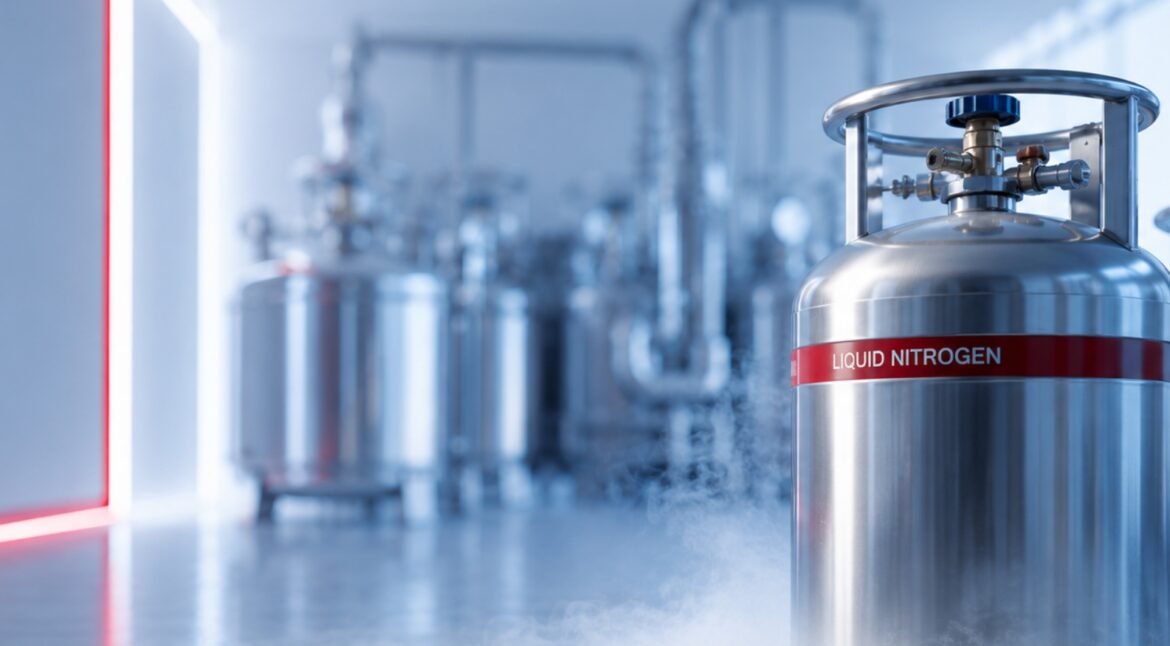
- Liquid cylinders are larger, pressurised vacuum-insulated vessels that can deliver liquid or gas to a process.
- Bulk storage tanks are filled by road tanker for sites with steady, higher consumption. Our guide to bulk liquid nitrogen supply explains how tanker supply works.
Liquid nitrogen must never be stored in a sealed, unvented container. As it evaporates, the gas needs a way to escape; otherwise pressure builds up inside the vessel.
Is Liquid Nitrogen Dangerous?
Liquid nitrogen is safe to use when people understand its hazards and follow proper procedures. The main risks are:
- Cold burns: contact with the liquid, cold vapour or super-cooled surfaces can damage skin and eyes very quickly.
- Oxygen depletion: in a poorly ventilated or enclosed room, evaporating nitrogen can displace oxygen. Because nitrogen has no smell or colour, people may not notice the danger.
- Pressure build-up: trapped liquid nitrogen that warms up can build dangerous pressure in a closed vessel or pipe.
Good ventilation, correct storage vessels, training and suitable cryogenic safety equipment such as cryogenic gloves, face shields and aprons all reduce these risks.
Frequently Asked Questions
What temperature is liquid nitrogen?
Liquid nitrogen boils at about −196 °C at normal atmospheric pressure.
Why does liquid nitrogen produce white fog?
The fog is moisture in the surrounding air condensing because of the cold. Nitrogen gas itself is invisible.
Can liquid nitrogen be stored in a closed bottle?
No. Liquid nitrogen must be stored in a vessel designed for it, with a way for evaporating gas to escape. A sealed container can build up dangerous pressure.
Where can I buy liquid nitrogen in India?
Spectra Cryogenic Systems supplies liquid nitrogen from Kota, Rajasthan, including bulk tanker supply across India in quantities of 6,000 L and 13,000 L.
Need a Liquid Nitrogen Supply?
Spectra Cryogenic Systems Pvt. Ltd. provides liquid nitrogen supply for industrial, medical, research and food processing use, with bulk tanker supply available across India. To discuss your requirement, call +91 98290 89936 or email spectracryo@yahoo.com.