Search for a vessel to store liquid nitrogen and you will meet several names: cryocan, dewar, liquid nitrogen container, LN2 container, cryogenic container. Sometimes they mean the same thing; sometimes they don’t. Different suppliers and industries use the terms in different ways, which can make comparing products confusing. This guide explains what people usually mean by a cryocan, a dewar and a liquid nitrogen container, how the terms overlap, and what to check before you buy, whatever the product is called.
Why the Terms Get Confusing
These names grew up in different places. “Dewar” comes from scientific and laboratory usage. “Cryocan” is common in everyday trade usage, particularly in India and in animal breeding programmes. “Liquid nitrogen container” is a plain description of what the vessel does. None of these is a strict, universal product classification, and the same product may be described with more than one of them.
The safest approach is to treat the name as a starting point and look at the product’s actual design, capacity, holding time and intended use.
What Is a Dewar?
In general technical usage, a dewar (or dewar flask) is a vacuum-insulated vessel designed to keep its contents at a very different temperature from its surroundings. It has an inner and outer wall separated by a vacuum space, which greatly reduces heat transfer.
The term is broad. It can describe small laboratory flasks, open-neck storage vessels for liquid nitrogen and, in some contexts, larger vacuum-insulated vessels. Because it is used so widely, “dewar” on its own does not tell you the size, pressure rating or intended use of a product.
What Do People Mean by a Cryocan?
In common usage, a cryocan usually refers to a portable, open-neck, vacuum-insulated vessel used to store liquid nitrogen and the samples kept in it, such as frozen semen straws or other biological material. In practice, many buyers use “cryocan” to mean a liquid nitrogen storage container.
Because “cryocan” is a trade term rather than a formal classification, check the product details rather than assuming two “cryocans” from different suppliers are equivalent.
What Is a Liquid Nitrogen Container?
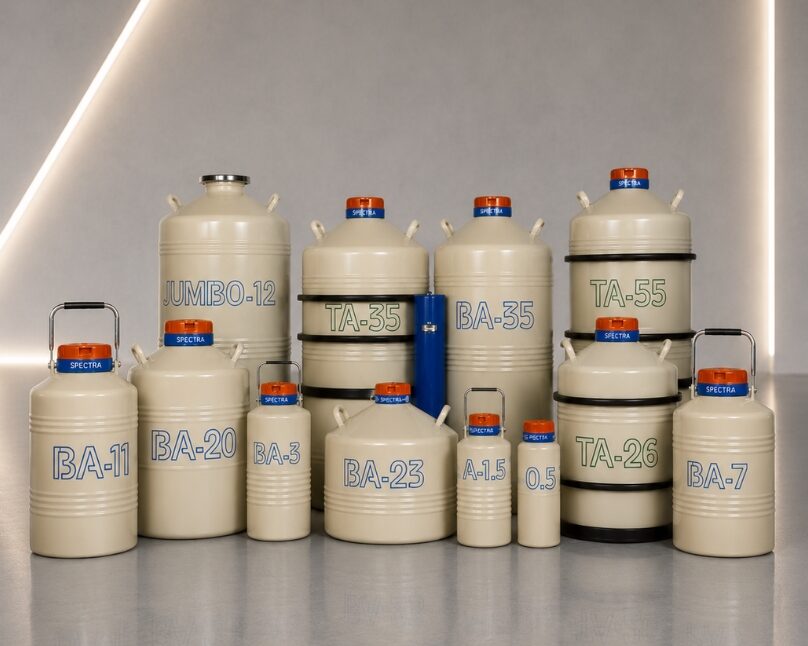
A liquid nitrogen container is a descriptive term for a vessel designed to hold liquid nitrogen, typically an open-neck, non-pressurised, vacuum-insulated vessel used for storage of samples and small quantities of liquid. This is the term Spectra Cryogenic Systems uses for its range.
Spectra’s liquid nitrogen containers are available from 1 L to 51 L, with holding times typically between 15 and 60 days, depending on the model.
How the Terms Compare
| Term | How it is commonly used | What to check |
|---|---|---|
| Dewar | Broad technical term for a vacuum-insulated vessel; can cover many sizes and designs | Size, design and intended use |
| Cryocan | Common trade term, usually for a portable open-neck liquid nitrogen storage vessel | Capacity, holding time, neck size and accessories |
| Liquid nitrogen container | Descriptive term for a vessel designed to hold liquid nitrogen; Spectra’s product name | Capacity, holding time and application |
One vessel that is often confused with these is the liquid cylinder, which is a closed, pressurised vessel used to supply liquid or gas. Our comparison of a liquid nitrogen container vs a liquid cylinder explains the difference.
What to Check Before Buying, Whatever It Is Called
1. Capacity
Capacity is the volume of liquid nitrogen the vessel holds. Match it to how much material you store and how the vessel will be moved and refilled. Spectra’s containers range from 1 L to 51 L.
2. Holding Time
Holding time is how long the vessel can keep liquid nitrogen before it needs refilling. It depends on the model and on how the vessel is used. Spectra’s range offers holding times typically between 15 and 60 days. Our guide How Long Does Liquid Nitrogen Last in a Storage Container? explains what affects it.
3. Intended Application
Tell the supplier what you will store and how: sample storage in a laboratory, field use, veterinary work or holding small quantities of liquid nitrogen. The application affects the right capacity, neck size and accessories.
4. Neck Size and Accessories
The neck opening affects how easily items can be placed and retrieved, and how much heat enters when the vessel is opened. Ask which canisters, racks or other accessories come with or suit the vessel.
5. Handling and Transport
Consider who will carry the vessel, how far, and how it will be secured during transport.
6. Care and Support
Ask how the vessel should be maintained and what support is available if it is damaged. Spectra also repairs liquid nitrogen containers; see LN2 Container Maintenance and Preventive Care.
Frequently Asked Questions
Is a cryocan the same as a dewar?
The terms often overlap. “Dewar” is a broad technical term for a vacuum-insulated vessel, while “cryocan” is a common trade term for a portable liquid nitrogen storage vessel. Check the product details rather than relying on the name.
Is a cryocan the same as a liquid nitrogen container?
In common usage, many buyers use “cryocan” to mean a liquid nitrogen storage container. Spectra Cryogenic Systems calls its range liquid nitrogen containers.
What capacities does Spectra offer?
Spectra’s liquid nitrogen containers are available from 1 L to 51 L.
How long does liquid nitrogen last in Spectra’s containers?
Holding times are typically between 15 and 60 days, depending on the model and on how the container is used.
For dewar flasks, valves, regulators and related items, see our cryogenic accessories.
Find the Right Container
Whatever you call it, the right vessel depends on capacity, holding time and application. To discuss Spectra’s liquid nitrogen containers, call +91 98290 89936 or email spectracryo@yahoo.com.