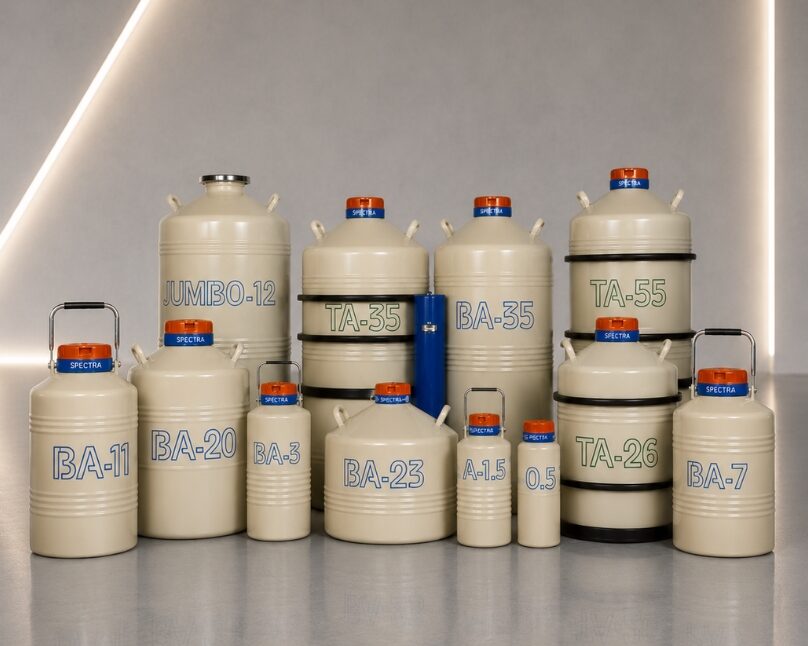
Liquid nitrogen containers and liquid cylinders are both vacuum-insulated vessels for cryogenic liquids, and buyers often use the names interchangeably. In practice they are built for different jobs. Choosing the wrong one can mean frequent refills, unnecessary handling or a vessel that simply does not fit the way you work. This guide compares a liquid nitrogen container vs a liquid cylinder and helps you decide which you need.
The Short Answer
- Choose a liquid nitrogen container if your main need is to store samples (such as biological samples) or to carry small quantities of liquid nitrogen.
- Choose a liquid cylinder if your main need is to supply liquid or gas to a process, or to keep a larger reservoir on site for refilling smaller vessels.
Many sites use both: a liquid cylinder as the on-site reservoir and several containers for storage at the point of use.
What Is a Liquid Nitrogen Container?
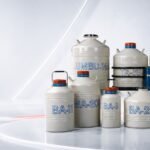
A liquid nitrogen container, also called a cryocan or dewar, is an open-neck, non-pressurised vessel with vacuum insulation between its inner and outer walls. Liquid nitrogen slowly evaporates and the gas escapes through the neck. Items to be preserved are usually placed inside the container, in canisters or racks, and kept immersed in or above the liquid nitrogen.
Spectra Cryogenic Systems offers liquid nitrogen containers from 1 L to 51 L, with holding times typically between 15 and 60 days depending on the model.
What Is a Liquid Cylinder?
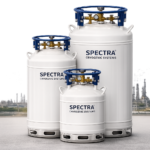
A liquid cylinder is a closed, pressurised vacuum-insulated vessel fitted with valves, gauges and pressure-relief devices. Rather than storing items inside, it stores the liquid itself and delivers it through its valves, as liquid or, depending on its design, as gas.
Spectra Cryogenic Systems supplies liquid cylinders in capacities from 180 L to 240 L, as a distributor.
Side-by-Side Comparison
| Liquid nitrogen container | Liquid cylinder | |
|---|---|---|
| Main purpose | Storing samples; carrying small quantities | Supplying liquid or gas; on-site reservoir |
| Pressure | Non-pressurised, open neck with loose-fitting lid | Closed and pressurised, with relief devices |
| Capacity at Spectra | 1 L to 51 L | 180 L to 240 L |
| How liquid is used | Items stored inside; liquid poured or decanted when needed | Liquid or gas drawn off through valves |
| Handling | Smaller sizes carried by hand | Heavy when full; moved with suitable handling equipment |
| Typical users | Veterinary use, laboratories and biological sample storage | Laboratories and industrial users needing a regular liquid or gas supply, or a refill reservoir |
Five Questions to Help You Decide
1. Are You Storing Items or Using the Liquid?
If you need to keep samples frozen, you need a container designed to hold them. If you need the liquid nitrogen itself, for cooling, processing or refilling, a liquid cylinder is often more convenient.
2. How Much Do You Use?
Small, occasional quantities suit containers. Regular use of larger volumes points towards a liquid cylinder. For high, steady consumption, bulk tanker supply into a storage tank may be the next step.
3. Do You Need Gas as Well as Liquid?
Containers supply liquid only. A liquid cylinder, depending on its design, can supply gas to equipment that needs it.
4. Where Will the Vessel Be Used?
Containers can be carried to remote locations, such as field veterinary work. Liquid cylinders are generally kept at a fixed location on site and moved only when needed.
5. Who Will Handle It?
Pouring from containers involves open liquid and repeated lifting. Drawing from a liquid cylinder reduces open handling but requires staff to be trained on valves, gauges and relief devices. In both cases, use suitable cryogenic PPE.
Using Both Together
A common set-up is a liquid cylinder as the site’s reservoir, used to refill several containers that store samples at the point of use. This reduces trips to refill containers elsewhere and keeps sample storage separate from the supply. Our guide Liquid Cylinders (180–240 L): Who Needs Them? covers what to check before buying a cylinder.
Frequently Asked Questions
Is a cryocan the same as a liquid cylinder?
No. “Cryocan” usually refers to an open-neck liquid nitrogen container used for storage. A liquid cylinder is a closed, pressurised vessel used to supply liquid or gas.
Which holds liquid nitrogen longer?
The two are used differently, so they are not directly comparable. For containers, Spectra’s range offers holding times typically between 15 and 60 days, depending on the model.
Can a liquid cylinder be used to refill containers?
Yes. Using a liquid cylinder as an on-site reservoir for refilling containers is a common arrangement. Follow the cylinder’s operating instructions and wear suitable PPE.
Can I buy both from Spectra?
Yes. Spectra Cryogenic Systems offers liquid nitrogen containers from 1 L to 51 L and supplies liquid cylinders from 180 L to 240 L.
Get Help Choosing
Not sure which vessel suits your work? Contact Spectra Cryogenic Systems Pvt. Ltd., Kota, Rajasthan, on +91 98290 89936 or at spectracryo@yahoo.com. Tell us what you need to store or supply and roughly how much liquid nitrogen you use.