Processors of spices, herbs, pharmaceutical ingredients and heat-sensitive polymers often reach a point where their existing mill is not giving the result they want. The powder loses aroma, the mill clogs, or the material will not grind as fine as needed without overheating. At that point the question becomes: cryogenic grinding vs conventional grinding, which is right for this material? This guide compares the two approaches and helps you decide whether cryogenic grinding is worth evaluating.
Conventional Grinding in Brief
In conventional grinding, material is fed into a mill at or near room temperature and broken down by impact, shear or attrition. The mechanical energy that breaks the material also produces heat. Some processes use air flow or water-cooled jackets to remove part of that heat, but the material itself is not deliberately chilled before grinding.
For many materials this works well. It is simple, widely understood and does not require a cryogenic liquid supply.
Cryogenic Grinding in Brief
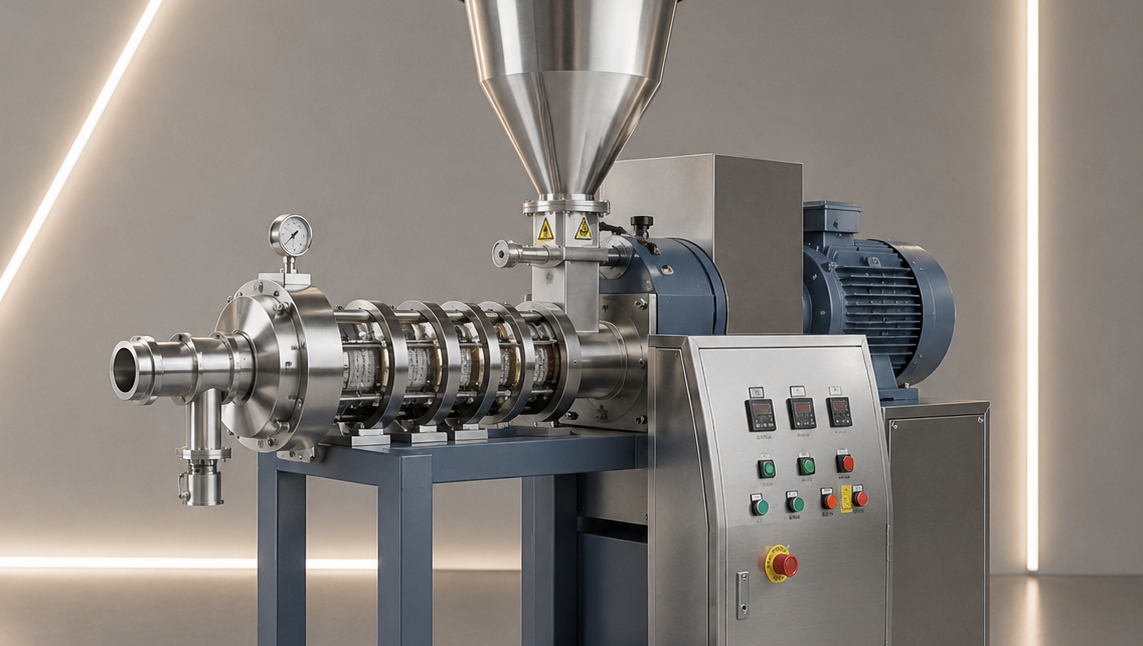
In cryogenic grinding, the material is cooled with liquid nitrogen before and during grinding. Cooling usually takes place in a dedicated cooling stage, often a screw-type cooler, before the material enters the mill. Liquid nitrogen evaporates as it absorbs heat, so the grinding zone is kept cold and filled largely with nitrogen gas rather than air.
The aim is to grind the material while it is cold and brittle, and to limit the heat that builds up during grinding. Our earlier article on cryogenic grinding for spices shows how this applies to one common application.
Side-by-Side Comparison
| Factor | Conventional grinding | Cryogenic grinding |
|---|---|---|
| Cooling approach | Material ground at or near room temperature; any cooling is indirect | Material chilled with liquid nitrogen before and during grinding |
| Heat during grinding | Heat from friction builds up in the material and mill | Heat is absorbed by the cold material and evaporating nitrogen |
| Heat-sensitive materials | Risk of aroma loss, colour change or degradation | Helps limit heat exposure |
| Oily or greasy materials | Can smear, stick or clog screens | Chilled material is firmer and tends to fracture rather than smear |
| Elastic or soft materials | May deform rather than break | Cooling can make some materials brittle enough to fracture |
| Grinding atmosphere | Usually air | Largely nitrogen gas, which can help limit oxidation |
| Particle size | Achievable fineness may be limited by heat or clogging for some materials | Can help achieve finer or more consistent results for some materials; depends on material and set-up |
| Additional requirements | Standard utilities | Reliable liquid nitrogen supply, storage, controls, ventilation and cryogenic safety measures |
| Operating cost factors | Power, maintenance | Power, maintenance and liquid nitrogen |
Heat-Sensitive Materials
Materials such as spices, herbs and some pharmaceutical ingredients contain components that can evaporate, oxidise or change when they warm up. In conventional grinding, the temperature of the material rises as it is ground, which can reduce aroma or affect other quality attributes. Cryogenic grinding keeps the material cold throughout, helping to limit that exposure.
Oily Materials
Oily and greasy materials tend to soften as they warm. In a conventional mill this can cause the material to smear, coat surfaces or block screens, which slows the process and makes cleaning harder. Chilling the material makes it firmer, so it is more likely to break into particles rather than smear.
Particle-Size Considerations
Particle size depends on many factors: the material, its moisture and oil content, the mill type, screens or classifiers, feed rate and cooling. Cryogenic grinding can help some materials grind finer or more consistently, mainly because it reduces heat-related problems such as clogging and softening. It does not ensure a particular particle size. Any target fineness should be discussed with the supplier for your specific material.
Process Considerations
- Liquid nitrogen supply: cryogenic grinding depends on a continuous and reliable supply of liquid nitrogen, stored on site.
- Additional equipment: a cooling stage, liquid nitrogen controls and storage are added to the grinding line.
- Condensation: cold powder can attract moisture from the air if it is exposed while still cold, so handling after grinding needs thought.
- Safety: operators work with a cryogenic liquid and nitrogen gas, so ventilation, training and PPE are essential.
- Running cost: liquid nitrogen is an ongoing operating cost that must be weighed against quality and productivity gains.
When Should You Evaluate Cryogenic Grinding?
Cryogenic grinding is worth evaluating when one or more of these is true:
- Your finished product is losing aroma, flavour or colour during grinding.
- Your material is oily or greasy and clogs or smears in the mill.
- Your material is soft or elastic and does not break cleanly at room temperature.
- You cannot reach the fineness you need without overheating the material.
- Product quality is important enough to justify the cost of liquid nitrogen.
If none of these applies, conventional grinding may remain the simpler and more economical option.
Questions to Ask a Supplier
- Which properties of my material make cryogenic grinding relevant?
- How is the material cooled, and how is liquid nitrogen controlled?
- What affects liquid nitrogen consumption for my material?
- What equipment, space and utilities will the line need?
- Can the system be customised for my material and requirement?
- What installation, training and technical support are available?
Frequently Asked Questions
What is the main difference between cryogenic and conventional grinding?
Cryogenic grinding chills the material with liquid nitrogen before and during grinding. Conventional grinding processes the material at or near room temperature.
Is cryogenic grinding always better?
No. It is most useful for heat-sensitive, oily, aromatic or elastic materials. For materials that grind well at room temperature, conventional grinding may be sufficient.
Does cryogenic grinding always produce a finer powder?
No. It can help some materials grind finer or more consistently, but particle size depends on the material, the mill and how the system is set up.
What extra requirements does cryogenic grinding have?
A reliable liquid nitrogen supply and on-site storage, cooling and control equipment, good ventilation, trained operators and suitable cryogenic PPE.
Talk to Spectra About Your Material
Spectra Cryogenic Systems Pvt. Ltd. offers cryogenic grinding systems for heat-sensitive, oily and aromatic materials, with customisation to suit your requirement. We also supply liquid nitrogen. To discuss whether cryogenic grinding suits your material, call +91 98290 89936 or email spectracryo@yahoo.com.