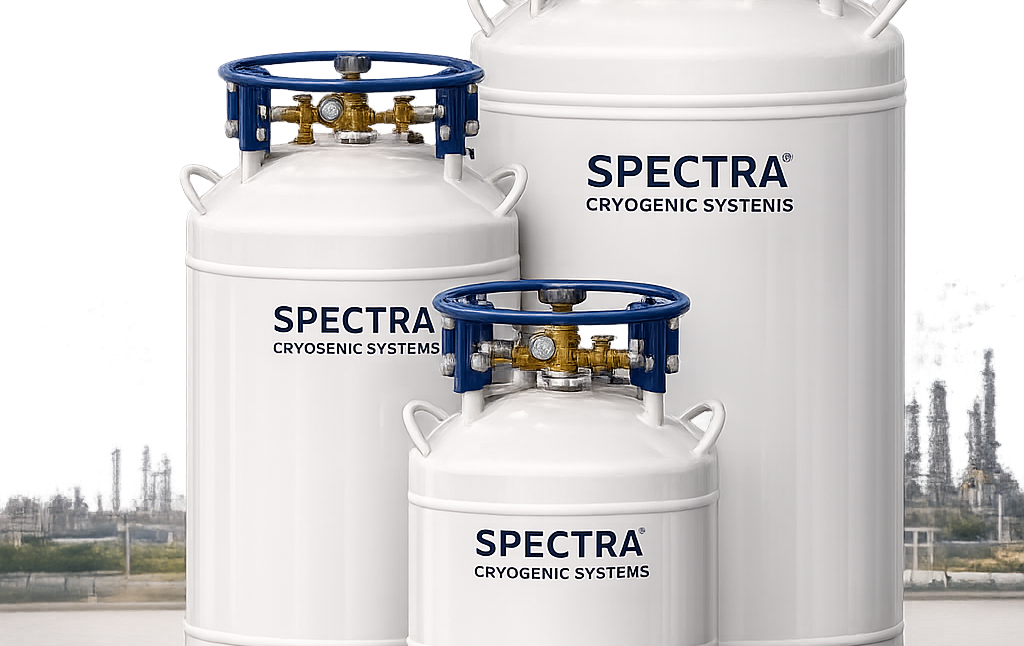
Many liquid nitrogen users start with small containers and then reach a point where carrying and refilling them becomes a daily task. Others need a steady supply of liquid or gas for a process but do not use enough to justify a bulk storage tank. For both groups, liquid cylinders are often the practical middle ground. This guide explains what liquid cylinders are, who typically uses them, and what to check before buying one in the 180 L to 240 L range.
What Is a Liquid Cylinder?
A liquid cylinder is a portable, vacuum-insulated vessel used to store a cryogenic liquid, such as liquid nitrogen, and to supply it to the point of use. It has an inner vessel that holds the liquid and an outer body, with a vacuum space between them to slow heat entering the liquid.
Unlike an open-neck liquid nitrogen container, a liquid cylinder is a closed, pressurised vessel. It is fitted with valves and gauges, and with pressure-relief devices that protect the cylinder as the liquid slowly evaporates. Depending on its design and fittings, a liquid cylinder can be used to:
- withdraw liquid, for example to refill smaller containers or feed a process; or
- withdraw gas, where the liquid is converted to gas for equipment that needs a gas supply.
Liquid Cylinders at Spectra: 180 L to 240 L
Spectra Cryogenic Systems supplies liquid cylinders in capacities from 180 L to 240 L, as a distributor. Cylinders in this range hold far more than a portable liquid nitrogen container, while still being movable around a site.
Who Needs a Liquid Cylinder?
A liquid cylinder is usually worth considering if one or more of these describes your situation:
You Refill Many Small Containers
Laboratories, research facilities and breeding or veterinary operations often keep several small containers topped up. A liquid cylinder on site can act as a local reservoir, so containers can be refilled when needed instead of waiting for each one to be filled elsewhere.
You Need a Steady Supply for a Process
Industrial users that need a regular supply of liquid or gas for cooling, processing or other operations can draw from a liquid cylinder instead of handling many smaller vessels.
Your Consumption Is Too Low for a Bulk Tank
Bulk tanker supply suits sites with steady, higher consumption and space for a storage tank. If your usage is lower or irregular, a liquid cylinder can provide on-site storage without the commitment of a bulk installation. If your usage is growing, read our guide to bulk liquid nitrogen supply to see when tanker supply makes sense.
You Want to Reduce Manual Handling
Pouring from small containers involves repeated lifting and decanting. Drawing liquid or gas from a liquid cylinder through its valves can reduce how often people handle open liquid.
When a Liquid Cylinder May Not Be the Right Choice
- Long-term sample storage: if the main job is to keep samples frozen, such as semen straws or biological samples, a liquid nitrogen container designed for storage is usually the better fit.
- Field and transport use: small containers are easier to carry by hand to remote locations.
- Very high, continuous consumption: a bulk storage tank filled by tanker may be more practical.
What to Check Before Buying a Liquid Cylinder
- Which liquid it is for. Cylinders are set up for a particular gas service. Confirm the cylinder is suitable for the liquid you intend to store.
- Liquid or gas withdrawal. Decide whether you need to draw liquid, gas or both, as this affects the fittings and how the cylinder is used.
- Capacity. Match the 180 L to 240 L range to your daily or weekly consumption and how often the cylinder can be refilled.
- Refilling arrangement. Plan where your liquid nitrogen supply will come from and how often the cylinder will be refilled.
- Floor space and movement. A filled liquid cylinder is heavy. Check the route from delivery point to point of use, including doorways, ramps and floor surfaces.
- Location and ventilation. Liquid cylinders release gas through their relief devices during normal use. Keep them in well-ventilated areas.
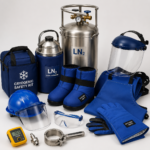
- Training. Make sure staff understand the valves, gauges and relief devices, and wear suitable cryogenic PPE when connecting and disconnecting.
Safety Basics for Liquid Cylinders
- Keep the cylinder upright and move it carefully, using suitable handling equipment.
- Never tamper with or block pressure-relief devices.
- Store and use cylinders in ventilated areas, away from heat sources.
- Wear cryogenic gloves and eye and face protection when making or breaking connections.
- Follow the operating instructions supplied with the cylinder.
Frequently Asked Questions
What capacities of liquid cylinders does Spectra supply?
Spectra Cryogenic Systems supplies liquid cylinders in capacities from 180 L to 240 L.
Is a liquid cylinder the same as a liquid nitrogen container?
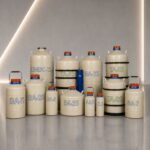
No. A liquid nitrogen container is an open-neck, non-pressurised vessel mainly used for storing samples and small quantities. A liquid cylinder is a closed, pressurised vessel with valves, used to supply liquid or gas.
Does Spectra manufacture these liquid cylinders?
Spectra Cryogenic Systems supplies these liquid cylinders as a distributor.
Can I get liquid nitrogen to fill the cylinder?
Yes. Spectra Cryogenic Systems supplies liquid nitrogen, including bulk tanker supply across India.
Discuss Your Liquid Cylinder Requirement
To find out whether a liquid cylinder suits your application, see our liquid cylinders page or contact Spectra Cryogenic Systems Pvt. Ltd., Kota, Rajasthan, on +91 98290 89936 or at spectracryo@yahoo.com. Please share the liquid you need to store, how much you use and whether you need liquid or gas withdrawal.