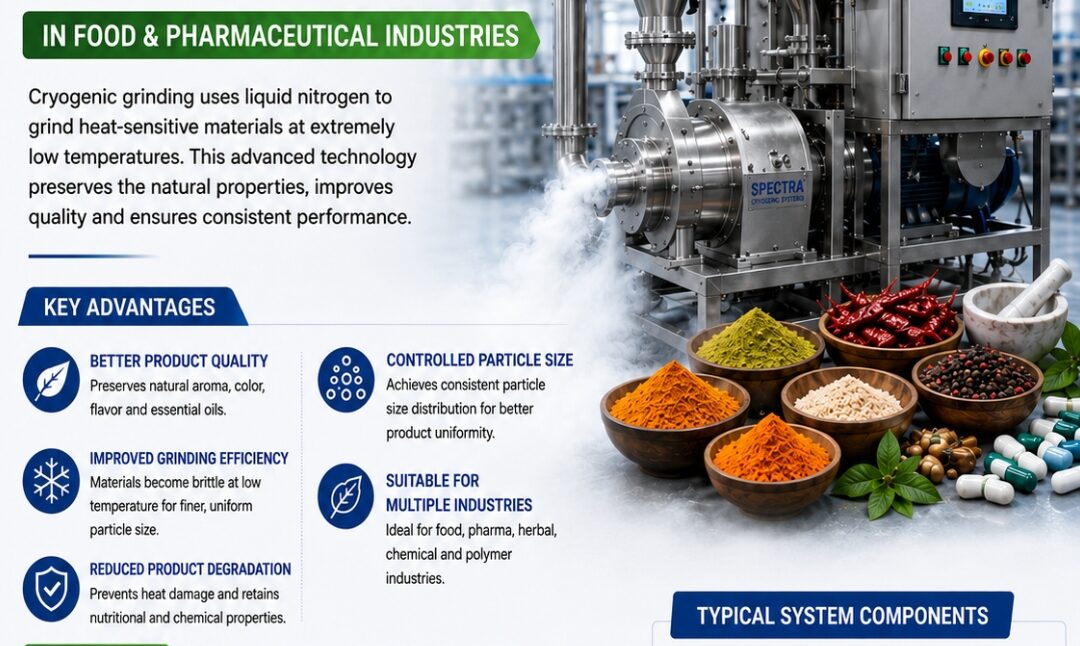
Cryogenic Grinding Systems have transformed the processing of heat-sensitive materials in food processing, pharmaceutical, herbal, and chemical industries. Unlike conventional grinding methods, cryogenic grinding uses liquid nitrogen to maintain extremely low temperatures during the grinding process.
This advanced technology helps preserve product quality, aroma, essential oils, and material characteristics while improving grinding efficiency and particle size control.
What Is Cryogenic Grinding?
Cryogenic Grinding is a low-temperature grinding process where materials are cooled using liquid nitrogen before and during grinding. The cooling process prevents heat generation and material degradation caused by conventional grinding methods.
Cryogenic grinding systems are especially useful for:
- Spices
- Herbs
- Pharmaceutical materials
- Heat-sensitive polymers
- Dry vegetables
- Food ingredients
Why Low-Temperature Grinding Matters
Traditional grinding methods generate heat due to friction, which may damage temperature-sensitive materials. In spices and herbs, excessive heat can result in:
- Loss of aroma
- Evaporation of essential oils
- Product discoloration
- Reduced product quality
Cryogenic grinding helps reduce these issues by keeping the material cold throughout processing.
Key Benefits of Cryogenic Grinding Systems
Better Product Quality
Low-temperature processing preserves natural aroma, color, flavor, and essential oils.
Improved Grinding Efficiency
Cryogenic cooling makes materials brittle, resulting in finer and more uniform grinding.
Reduced Product Degradation
Heat-sensitive materials remain protected during processing.
Controlled Particle Size
Advanced cryogenic systems help achieve consistent particle size and better product uniformity.
Suitable for Multiple Industries
Cryogenic grinding systems support food processing, pharmaceuticals, chemicals, and research applications.
Applications of Cryogenic Grinding
Cryogenic grinding technology is widely used in:
- Spice processing industries
- Herbal product manufacturing
- Pharmaceutical processing
- Polymer industries
- Food processing sectors
- Research laboratories
Features of Modern Cryogenic Grinding Systems
Advanced cryogenic grinding systems include:
- Feed conveyor systems
- Screw coolers
- Cyclones
- Pin mills
- Automatic filters
- Control units for liquid nitrogen
- Advanced temperature control systems
These systems ensure efficient and continuous industrial performance.
Frequently Asked Questions
Which materials benefit most from cryogenic grinding?
Heat-sensitive and oily materials such as spices and herbs, where conventional grinding can cause loss of aroma and essential oils, or where oily material becomes sticky and difficult to grind.
Why is liquid nitrogen used?
Liquid nitrogen, at about −196 °C, cools the material before and during grinding, making it brittle and absorbing the heat generated by grinding.
Can a cryogenic grinding system be customised?
Yes. Spectra’s cryogenic grinding systems can be customised to the material and the process.
Conclusion
Cryogenic Grinding Systems provide an advanced and efficient solution for processing heat-sensitive materials while preserving product quality and operational efficiency. The technology is widely preferred in food processing and pharmaceutical industries due to its reliable low-temperature performance.
Spectra Cryogenic Systems Pvt. Ltd., Kota, Rajasthan, offers cryogenic grinding systems for spices, herbs, oily and heat-sensitive materials, with liquid nitrogen cooling, particle-size control and customisation, and supplies the liquid nitrogen to run them. Call +91 98290 89936 or email spectracryo@yahoo.com.